
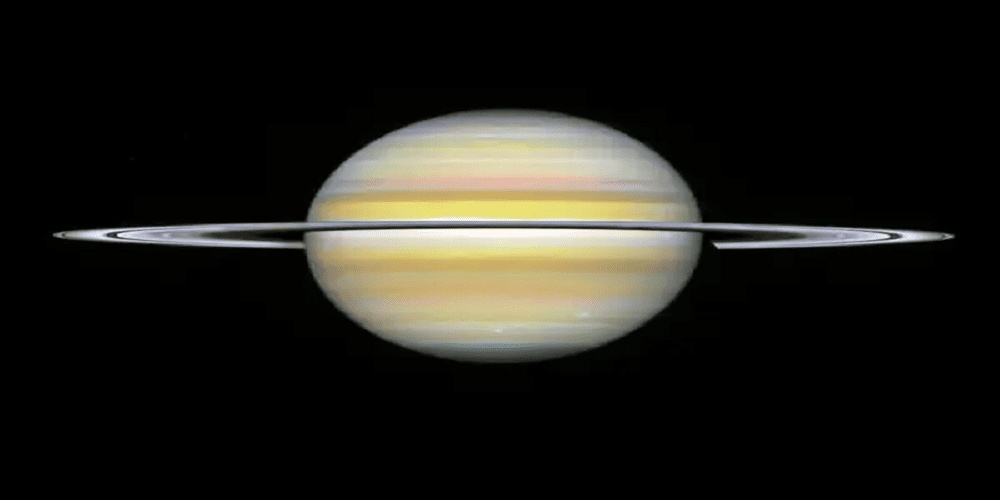
Saturn has always been one of the most fascinating planets in our solar system. Its spectacular rings are easy to recognize, but the planet itself hides some of the strangest weather systems known to science. For decades, scientists have studied the famous hexagon at Saturn’s north pole. Now, a new discovery is attracting attention: a giant 10-sided atmospheric wave surrounding the planet’s south pole.
The saturn decagon south pole feature was identified through observations made by the NASA/ESA Hubble Space Telescope. Unlike a solid geometric shape sitting on the planet’s surface, this decagon is an atmospheric phenomenon. It is a large wave embedded within one of Saturn’s powerful jet streams.
The discovery is particularly interesting because scientists had searched for a southern counterpart to Saturn’s northern hexagon for many years. Observations from NASA’s Cassini spacecraft did not reveal a similar long-lasting structure during its mission from 2004 to 2017. Hubble observations eventually provided evidence that the saturn decagon south pole structure had begun emerging by 2023.
Scientists are now studying how such an unusual pattern can form in a rapidly rotating atmosphere. The discovery could provide new information about Saturn’s weather, jet streams, seasonal changes and atmospheric circulation.
What Is the Saturn Decagon South Pole?
The saturn decagon south pole is a large, roughly 10-sided atmospheric wave located around Saturn’s southern polar region. NASA describes it as a giant, evolving atmospheric wave rather than a permanent physical structure.
The feature is centered around 63 degrees south latitude and lies within one of Saturn’s strong jet streams. Hubble observations at different wavelengths show that the structure extends through multiple atmospheric layers. This is important because it suggests that the pattern is not simply a shallow arrangement of clouds visible near the top of the atmosphere.
The word “decagon” refers to a shape with ten sides. However, the structure should not be imagined as a perfectly engineered geometric figure. Atmospheric waves are constantly influenced by winds, temperature differences and circulation. As a result, the saturn decagon south pole is expected to change over time.
Images released by NASA show a striking pattern around the southern pole, with atmospheric bands forming a roughly 10-sided boundary around a darker central region. The feature has become more clearly defined in observations made since 2023.
How Was the Decagon Discovered?
The story of the saturn decagon south pole discovery is closely connected with long-term observations of Saturn.
Scientists had already known about Saturn’s unusual northern hexagon for decades. The hexagonal pattern was first detected by NASA’s Voyager spacecraft during its encounters with Saturn in the early 1980s. Later observations by Cassini revealed the feature in much greater detail.
Because Saturn has broadly symmetrical northern and southern jet-stream systems, researchers naturally wondered whether the southern hemisphere might contain a similar atmospheric pattern.
However, finding it was not easy.
Saturn’s southern polar region was not always ideally positioned for observation from Earth. The planet’s seasonal cycle also affects how much sunlight reaches each hemisphere. During Cassini’s mission, researchers did not see evidence of a comparable long-lived polygonal structure at the south pole.
The Hubble Space Telescope eventually changed the picture.
Researchers examining Hubble observations noticed subtle signs of an unusual wave around the southern pole. Observations from 2023 and later years showed that the pattern became increasingly recognizable. Ground-based observations also helped researchers follow the developing feature.
According to NASA, scientists had been searching Hubble images for a southern counterpart to the famous northern hexagon since the 1990s. The Hubble data finally confirmed that the saturn decagon south pole feature was present as early as 2023.
Why Is the Saturn Decagon South Pole Important?
The importance of the saturn decagon south pole discovery goes far beyond its unusual appearance.
Saturn is a gas giant with no solid surface like Earth’s. Much of what we see is the result of complex atmospheric circulation. Deep inside its atmosphere, powerful winds move gases around the planet, creating bands, storms, vortices and waves.
Studying these features allows scientists to understand how energy moves through a planetary atmosphere.
The northern hexagon has already provided researchers with valuable information about Saturn’s jet streams. The newly observed southern decagon gives scientists another natural laboratory for studying atmospheric dynamics.
The two structures are also different.
Saturn’s northern hexagon is remarkably stable and has persisted for decades. The southern decagon appears to be more dynamic and evolving. This difference raises an important question: why can similar atmospheric environments produce different geometric patterns?
The answer may involve Saturn’s seasonal cycle, differences in atmospheric conditions or the interaction between jet streams and other weather systems.
How Large Is the Decagon?
The scale of the saturn decagon south pole structure is difficult to appreciate from ordinary photographs.
Reports based on the observations indicate that the feature is enormous. Its overall width is comparable to the scale of Saturn itself, while individual sides can extend for thousands of miles.
Some estimates put the entire structure at more than 100,000 miles across. Individual sides can stretch more than 10,000 miles.
That makes the phenomenon vastly larger than anything resembling a conventional weather system on Earth.
Earth’s largest hurricanes may appear enormous from our perspective, but Saturn’s atmosphere operates on a completely different scale. Saturn is much larger than Earth, and its rapid rotation and deep gaseous atmosphere allow atmospheric structures to persist and develop across immense distances.
The saturn decagon south pole therefore represents a planetary-scale atmospheric wave rather than an ordinary storm.
Is the Decagon a Storm?
Calling the saturn decagon south pole a storm can be misleading.
The feature is an atmospheric wave associated with a jet stream. Saturn does have powerful polar storms and vortices, but the decagon itself is not simply a giant hurricane with ten sides.
A useful way to understand it is to imagine a fast-moving atmospheric current that develops a repeating wave pattern. Instead of moving in a perfectly circular path, the jet stream can develop large-scale disturbances. Under the right conditions, those disturbances can produce polygon-like shapes.
Saturn’s northern hexagon is believed to be produced by this kind of atmospheric behavior. The newly observed southern decagon appears to have a related connection with a jet stream.
However, scientists do not yet have a complete explanation for why the southern pattern has ten sides or why it developed when it did.
The Connection With Saturn’s Famous Hexagon
Any discussion of the saturn decagon south pole naturally leads to Saturn’s northern hexagon.
The hexagon is one of the most recognizable atmospheric features in the solar system. It surrounds Saturn’s north pole and has remained remarkably stable for decades.
NASA observations have shown that the hexagon is associated with a powerful jet stream. The jet stream moves around the pole at extremely high speeds, while the wave pattern itself remains relatively stationary compared with the surrounding atmosphere.
The northern feature has six sides, whereas the saturn decagon south pole has approximately ten.
This difference is scientifically valuable. If both patterns are related to Saturn’s jet streams, studying them together could help researchers understand how the number of sides in a planetary atmospheric polygon is determined.
Scientists may be able to compare wind speeds, atmospheric temperatures, wave patterns and vertical structures to identify the conditions responsible for the different shapes.
Why Does Saturn Produce Geometric Weather Patterns?
One of the most interesting questions surrounding the saturn decagon south pole is why Saturn appears capable of producing such regular atmospheric geometry.
Planets often have jet streams and atmospheric waves. Earth has large-scale Rossby waves, meandering jet streams and persistent weather patterns. Jupiter also has long-lasting storms and polygonal arrangements of cyclones near its poles.
But Saturn’s hexagon is particularly striking because of its long-term stability and clearly defined sides.
The saturn decagon south pole adds another example to the list.
A possible explanation involves fluid dynamics. Saturn’s atmosphere behaves like a huge rotating fluid system. When winds traveling at different speeds interact, waves can develop along boundaries between atmospheric currents.
Saturn’s rapid rotation also influences the movement of atmospheric material. The combination of rotation, wind shear and atmospheric stability can create conditions in which waves become organized into unusual patterns.
Still, researchers do not yet know exactly why the southern feature developed into a decagon.
Does the Decagon Move?
Yes. One of the notable differences between the saturn decagon south pole and the northern hexagon is their behavior.
The northern hexagon is considered a relatively stationary wave pattern. The atmospheric gases themselves continue moving through the jet stream, but the overall geometric wave remains in roughly the same location.
The southern decagon appears to move eastward. Some reports estimate its movement at approximately 6 miles per hour, or about 10 kilometers per hour.
That may sound slow compared with Saturn’s powerful winds, but it is significant for a planetary atmospheric structure.
Researchers also estimate that the feature takes roughly hundreds of Earth days to complete a full circuit, with some observations suggesting a period of around 800 days.
Because the saturn decagon south pole is still evolving, these measurements may become more precise as additional observations are collected.
Why Was It Not Seen by Cassini?
This is one of the most intriguing aspects of the saturn decagon south pole story.
NASA’s Cassini spacecraft spent more than 13 years studying Saturn and its moons. It provided an extraordinary amount of information about the planet’s atmosphere, rings and magnetic environment.
Yet Cassini did not reveal a southern decagon.
That does not necessarily mean the feature did not exist at all during the mission. Instead, scientists think the decagon may have developed later.
Cassini ended its mission in 2017 when it was deliberately sent into Saturn’s atmosphere. Hubble observations later showed evidence of the southern structure beginning to emerge around 2023.
This gives researchers an opportunity to study a planetary atmospheric phenomenon while it is developing rather than observing only a mature structure.
The timing could be particularly useful for understanding what triggers the formation of the saturn decagon south pole.
Could Saturn’s Seasons Be Responsible?
Saturn experiences seasons because its rotational axis is tilted relative to its orbit around the Sun.
A Saturn year lasts about 29.5 Earth years, meaning each season lasts several Earth years. As Saturn moves around the Sun, the amount of sunlight received by its northern and southern hemispheres changes.
Seasonal heating can influence atmospheric temperatures and circulation.
Researchers are therefore interested in whether Saturn’s seasonal cycle played a role in the development of the saturn decagon south pole.
It is too early to say that seasonal changes directly caused the feature. Scientists need more observations and atmospheric modeling before drawing such a conclusion.
However, the timing is interesting enough to make seasonal effects an important area of research.
Future Hubble observations should help scientists determine whether the structure changes as Saturn moves through its seasonal cycle.
What Can Hubble Tell Scientists?
The Hubble Space Telescope has a major advantage when studying the saturn decagon south pole: it can observe Saturn repeatedly from Earth without requiring a spacecraft to travel there.
Hubble’s Wide Field Camera 3 can observe Saturn at different wavelengths. Different wavelengths can reveal atmospheric layers at different altitudes.
This is particularly important for the decagon.
NASA reports that the structure extends through multiple levels of Saturn’s atmosphere. The apparent position of the wave can also shift slightly depending on the wavelength being observed.
That means scientists are not looking at a single flat layer of clouds. Instead, they are getting information about a three-dimensional atmospheric structure.
Long-term observations can also reveal how the feature changes in size, shape, brightness and speed.
Could the Decagon Disappear?
It is possible.
Unlike Saturn’s northern hexagon, which has survived for decades, the saturn decagon south pole appears to be a younger and more changeable phenomenon.
Scientists are still determining how stable it is.
Atmospheric waves can strengthen, weaken, shift or disappear depending on the conditions that sustain them. If the jet stream changes significantly, the polygonal pattern could eventually lose its recognizable shape.
Alternatively, the feature may become more stable over time.
This uncertainty is one reason continued observations are so valuable. Researchers are essentially watching a planetary weather system evolve in real time.
What Does This Discovery Mean for Planetary Science?
The discovery of the saturn decagon south pole adds another important piece to the puzzle of planetary atmospheres.
Scientists studying planets cannot always recreate the conditions found on worlds such as Saturn in laboratories. Instead, they rely on observations, computer simulations and comparisons between different planets.
The decagon offers a new example of how atmospheric waves can organize themselves.
Researchers can compare Saturn’s southern feature with its northern hexagon, Jupiter’s polar cyclones and atmospheric waves found on other planets.
Such comparisons may reveal universal principles of fluid dynamics that operate across the solar system.
The saturn decagon south pole may therefore be more than an unusual photograph. It could become an important case study for understanding how rotating atmospheres behave on giant planets.
What Happens Next?
The next step is continued observation.
Scientists want to determine how long the saturn decagon south pole will survive, whether its shape becomes more regular or irregular, and how its movement changes.
They also want to understand its relationship with the surrounding jet stream.
Future observations could reveal whether the decagon grows, contracts, changes brightness or interacts with nearby atmospheric storms.
Saturn’s changing seasons provide another opportunity. Because the planet takes almost three decades to orbit the Sun, researchers can study the feature over a substantial portion of a planetary seasonal cycle.
The longer the observation record becomes, the easier it will be to distinguish temporary behavior from long-term atmospheric processes.
Final Thoughts on the Saturn Decagon South Pole
The discovery of the saturn decagon south pole has opened a new chapter in the study of Saturn’s extraordinary atmosphere. For decades, the northern hexagon was the planet’s most famous atmospheric mystery. Now, scientists have identified a striking 10-sided wave in the southern hemisphere.
The feature is enormous, dynamic and apparently much younger than the northern hexagon. Hubble observations show that it extends through multiple atmospheric layers and has become increasingly distinct since 2023.
Scientists still do not have all the answers. They do not yet know exactly why the wave has ten sides, what triggered its development or how long it will survive.
That uncertainty is what makes the saturn decagon south pole so scientifically valuable.
Rather than being a simple geometric shape, it is a window into the complicated fluid dynamics of a gas giant. As astronomers continue monitoring Saturn, the strange southern decagon could help explain not only one of the planet’s newest mysteries but also how large-scale weather patterns form on worlds far beyond Earth.
For now, Saturn continues to demonstrate that the solar system is full of phenomena that can challenge even our best understanding of planetary weather.
Frequently Asked Questions
1. What is the Saturn decagon south pole?
The saturn decagon south pole is a giant 10-sided atmospheric wave surrounding Saturn’s southern polar region. It is embedded within a powerful jet stream and is not a solid structure on the planet.
2. When was the Saturn south pole decagon discovered?
Hubble observations confirmed that the saturn decagon south pole was present as early as 2023. The feature became increasingly clear in observations made during subsequent years.
3. Is the Saturn decagon similar to the northern hexagon?
The saturn decagon south pole and Saturn’s northern hexagon are both large polygonal atmospheric patterns associated with jet streams. However, the northern hexagon is much more stable, while the southern decagon appears to be evolving and moving.
4. How big is the Saturn south pole decagon?
The saturn decagon south pole is enormous, spanning more than 100,000 miles in overall extent according to estimates reported from the observations. Individual sides can measure more than 10,000 miles.
5. Why does Saturn have a decagon at its south pole?
Scientists believe the saturn decagon south pole is connected to atmospheric waves within a powerful jet stream. However, the exact reason it developed a 10-sided pattern is not yet fully understood. Researchers are continuing to study its movement, structure and relationship with Saturn’s seasonal atmosphere.
Leave A Comment
0 Comment